

August 8, 2024
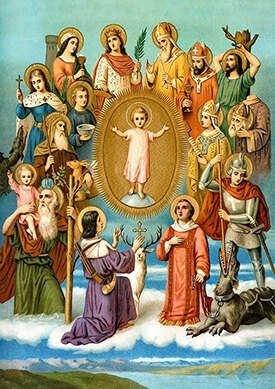 A German book from the 1500s had the remarkable account of a miraculous vision by a young shepherd boy — a vision of 14 children surrounding the Christ child who came with a message of hope for a troubled time, when the bubonic plague was ravaging Europe. Their message was: “We are the Fourteen Holy Helpers …. Serve us, and we will serve you.”
They requested that a chapel be built. By 1448, an altar was consecrated and pilgrims began to come. They continue to this day to visit the Basilica of Vierzehnheiligen (14 Holy Helpers) in Bavaria. The church, which was built in 1772, is one of the most popular pilgrimage destinations in Germany.
Devotion to the 14 saints began during an outbreak of the Black Death, from 1346 to 1349. The saints, who are venerated as a group, include three bishops, three virgin martyrs, three soldiers, a physician, a monk, a deacon, a young boy and a giant. All but one were martyred. Each had a special gift from God to intercede for a particular need, especially when people are facing trials. Today is their feast day.`
St. Acacius (May 7) of Cappadocia was a 4th-century martyr who served as a captain in the Roman army.
St. Barbara (December 4) was a 3rd-century virgin martyr from Egypt believed to be the daughter of a rich pagan who locked her in a tower. Upon learning she converted to Christianity, he denounced her to the authorities.
St. Blaise (February 3) was a 4th-century bishop and physician in Armenia. After his arrest, he was visited by a woman and her son, who had a fish bone caught in his throat. Blaise blessed him and the bone was dislodged.’
St. Catherine of Alexandria (November 25) was a 4th-century martyr, the daughter of the Queen of Egypt.
St. Christopher (July 25) converted after being instructed by a monk. Pious legend says he was a giant who carried travelers across a river. On one occasion, he was taking a child across who announced he was Christ and told him to change his name to Christopher.
St. Cyriacus (August 8) was a 4th-century Roman deacon. The emperor Diocletian called him to cure his daughter of blindness, which he did in the name of Jesus. However, the emperor Maximian later beheaded him.
St. Denis (October 9) was born in Italy and Pope Clement made him a missionary to France, where he became the first bishop of Paris. In 95, he was beheaded.
St. Erasmus (June 2) was a 4th-century Italian bishop martyred during the persecution of Diocletian. Also called St. Elmo, he is the patron of sailors.
St. Eustace (September 20) was a pagan general. When he saw a stag with a glowing crucifix between its antlers, he and his family converted.
St. George (April 23) was a 4th-century tribune in Diocletian’s army who refused to sacrifice to Roman gods. He was martyred.
St. Giles (September 1) was a 7th-century monk from Athens who founded a Benedictine community in France, where he fled to live as a hermit.
St. Margaret of Antioch (July 20) was the daughter of a pagan priest who was converted by her nurse. A consecrated virgin, she refused the advances of a wealthy Roman and was brought to court and ordered to renounce her faith. She refused and was beheaded.
St. Pantaleon (July 27) was a 4th-century Christian doctor employed by the emperor Maximian. He professed his faith and was martyred.
St. Vitus (June 15) was the son of a pagan senator in Sicily who learned about Christianity from his nurse and converted many to the faith. He was later martyred.
***
Sign Up for Healing Journey Messages
Receive a daily message to your email address.