


April 4, 2026
The following is taken from a homily by Fr. Peter Cipriani, pastor of St. Rose of Lima Church in Newtown.
I am sure we are all familiar with Michelangelo’s the Pieta…and what might this sculpture of intense suffering teach us? It is a marble sculpture of the Blessed Virgin Mary, holding in her arms not only her little boy, but her God who has died upon the Cross.
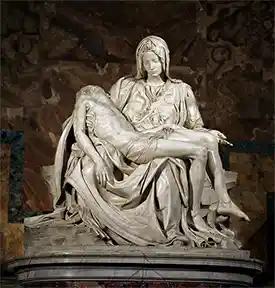 Unlike most artists of the time, Michelangelo did not want to sculpt a face for Christ that showed his pain and suffering but on his success in providing a way for men and God to be reunited. Michelangelo sculpted Mary’s face to appear young, a symbol of incorruptible and eternal beauty.
This artistic choice again draws attention away from the death of Christ and focuses on the good news: that he has triumphed over sin and offers to us the ability to repent and be reconciled to God. Mary’s face suggests that she is aware of the success of her son in accomplishing this great work. And does not the word Gospel mean “good news”?
This sculpture makes one feel hopeful. Christ is dead, but his work is done and his face shows no more pain. The peace on Mary’s face seems to suggest that one can find peace and rest with Christ; he has paid the price for us, and we can return to God because of him. Though Christ’s body lies in Mary’s arms, Michelangelo’s work evokes in one hope, coupled with the sorrow, for the future. And this is the nature of Mary’s sorrow. Sorrow is another profound experience and demonstration of great love. How could we feel deep sorrow unless we had felt deep love?
And any experience of love, especially when felt in sorrow, is meant to enlarge our hearts, not shrink them, with a greater compassion for others who beside us must travel that road to Calvary and beyond. Isn’t the Way of the Cross the way of every person’s life? Doesn’t every life have suffering, falls, hurts, rejections, condemnations, death, burial…and resurrection?
The Sorrow of Mary can be measured according to her love for Jesus, and since no one had a greater love for Christ, with the exception of Christ, no one has ever experienced or plumbed deeper the depths of sorrow and grief more than Mary. But this is a sorrow that is not reserved only for her child, but for all her children. In that moment, Mary is holding all of us to her maternal broken heart, knowing the pains we would all have to endure, especially by way of dying and death.
***
Sign Up for Healing Journey Messages
Receive a daily message to your email address.