
May 30, 2025
Almost 760 years ago, a priest from Prague was making a pilgrimage to Rome and stopped at the Basilica of Bolsena to celebrate Mass. It was a contentious time in Church history. There had been murmuring by certain theologians, who claimed the doctrine of the Real Presence — that Jesus is present Body, Blood, Soul and Divinity in the Eucharist — was not true. Father Peter was troubled by his own doubts.
As he elevated the host during the consecration, he was overwhelmed by what occurred: “Suddenly, the host appeared in a visible way as true Flesh, sprinkled with red Blood.”
The priest interrupted Mass and hurried to the town of Orvieto to tell Pope Urban IV, who immediately sent emissaries to investigate. He enshrined the host and linen, stained with the blood of Christ, in the Cathedral of Orvieto, where they are to this day.
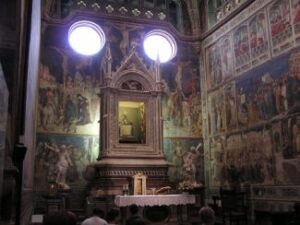 The miracle inspired the pope to institute the Feast of Corpus Christi in 1264, also known as the Solemnity of the Most Holy Body and Blood of Christ — which commemorates the institution of the Eucharist and celebrates the Real Presence. It is observed on the Thursday or Sunday following Trinity Sunday.
The pope asked the Dominican friar Thomas Aquinas to compose the Liturgy of the Hours and the sequence for the Mass of Corpus Christi. The hymns St. Thomas Aquinas wrote for the occasion are among the most beloved — Panis Angelicus, Tantum Ergo, and O Salutarius Hostia.
The feast originated as Festum Eucharistiae in Liege in 1246 at the prodding of St. Juliana, a nun and mystic, who received a vision from Christ, telling her he wanted a liturgical celebration to honor the Eucharist.
Corpus Christi, which is Latin for “Body of Christ,” celebrates his Real Presence in the consecrated bread and wine and recalls Holy Thursday, when Jesus observed the last Passover meal with his disciples and instituted the sacrament with the words, “This is my body…This is my blood.”
Receiving Jesus in the Blessed Sacrament should be a part of everyone’s healing journey.
Hear Andrea Bocelli sing Panis Angelicus in St. Peter’s Square:
https://youtu.be/y0gxy9al3hk?si=hTBT4W5xcUKBDvjS
The translation into English:
“The angel’s bread becomes the bread of men
The heavenly bread ends all symbols
Oh, miraculous thing! The body of the Lord will nourish
The poor, poor, and humble servant
The poor, poor, and humble servant.”
***
Sign Up for Healing Journey Messages
Receive a daily message to your email address.